Four rules.
Emergence in Conway's Game of Life
Phil Johnson · Reality after Einstein · 19 October 2026
Open on your phone, we'll use it soon:

philjohnsongh.github.io/life
Four rules.
Emergence in Conway's Game of Life
Phil Johnson · Reality after Einstein · 19 October 2026
Open on your phone, we'll use it soon:
philjohnsongh.github.io/life
Act 1 · Four rules
A live square with 0 or 1 live neighbours dies.
A live square with 2 or 3 live neighbours stays alive.
A live square with 4 or more live neighbours dies.
An empty square with exactly 3 live neighbours comes alive.
Every square has eight neighbours: sides and corners.
All squares change at the same moment. Count everything first, then update.
Idea 1 · That is the whole universe. There is nothing else.
Groups of three. One counts, one writes, one checks.
Corners count. Nothing changes until every square has been counted.
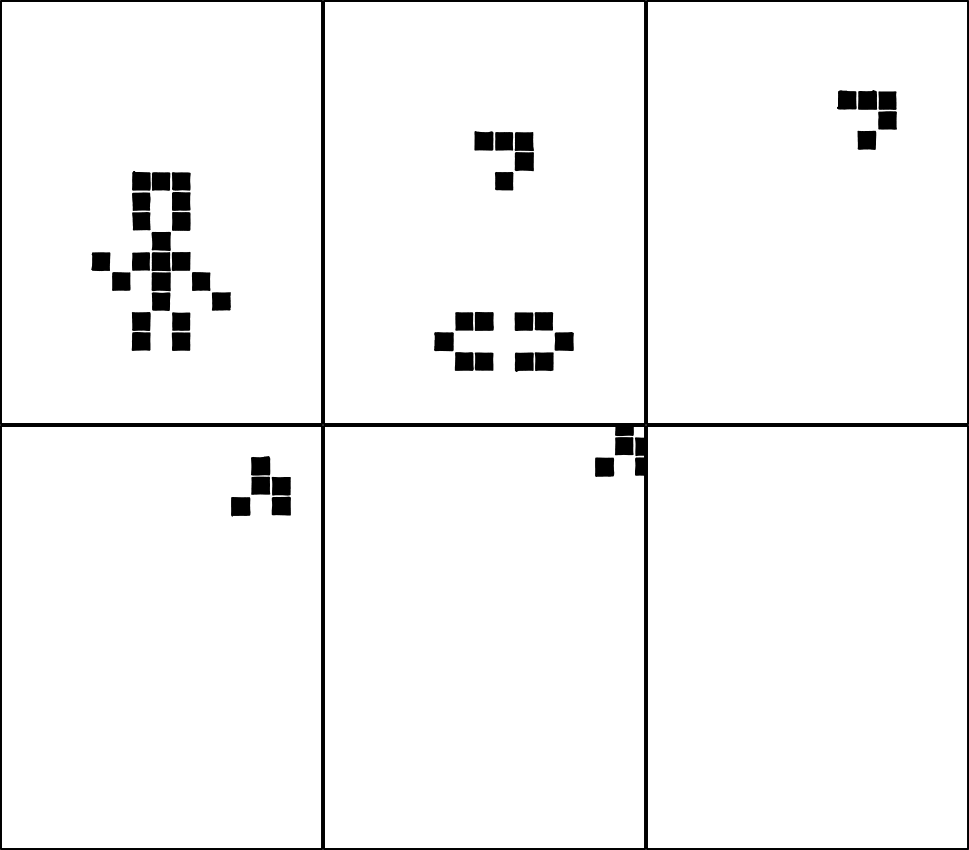
Nobody told it to move. No square moved. The glider did.
philjohnsongh.github.io/life
1. Tap squares to draw the blinker.
2. Press Step. Was your handout right?
3. Press Play.
Show counts on the Small board shows the neighbour numbers.
Act 2 · Nobody designed the glider
The rules never mention any of these. People found them, and named them, like animals in a new forest.
1. Big board. Press Random.
2. Speed 30. Press Play. Hand up.
3. Hand down when it says Settled.
What is left when the boiling stops? Blocks, blinkers, beehives: ash.
So is that all Life can do?
1. Clear the board. Draw any five squares.
2. Press Play.
3. Watch the generation counter until it says Settled.
4. Shout out your best number.
Act 2 · Nobody designed the glider
The acorn: seven squares.
You know every rule. You ran them by hand. And still the only way to find out what seven squares do is to run them.
It is a theorem that some simple yes-or-no questions about Life patterns cannot be answered by any computer, in general.
Idea 2 · The rules don't know what they will do.
Act 2 · Nobody designed the glider
1931 · Kurt Gödel
Any system of mathematics rich enough to count has true statements it can never prove. Not "not yet": never.
1936 · Alan Turing
He invented the universal computer on paper, then proved no program can tell, for every program, whether it will ever stop.
1970 · Conway's Life
Life can run any program (Act 3). So "will this pattern ever settle?" has no general answer. Run it, and wait.
Three faces of one limit: some yes-or-no questions have answers that no proof and no computer can reach. Four rules are already enough to hit it.
Act 2 · Nobody designed the glider
Life runs forwards only. Many different boards lead to the same next board, so you can never run it backwards.
That means some boards have no yesterday at all. Nothing in the universe can produce them. They can only be a beginning.
Life people call them Gardens of Eden. Proving one exists took a theorem (Moore and Myhill, 1962–63); finding small ones takes a computer search.
Act 2 · Nobody designed the glider
No square moves. A square has no idea it is part of a glider. It only lives or dies.
And yet the glider moves. It has a speed. You can count gliders. You can bounce them off each other.
A new level. Real, and never mentioned by the rules.
Two guns. The right one is a clock. The left one carries the message: for a 1 its glider goes through, for a 0 we delete it.
Where a message glider meets a clock glider, both die.
What comes out is the opposite of what went in: a NOT gate. Two more kinds of collision give AND, OR and memory.
Act 3 · It goes all the way up
Nicolas Loizeau, 2016: a programmable 8-bit computer made of glider streams, with a screen. It runs programs. Slowly.
Anything your laptop can compute, this can compute.
At home: Alan Zucconi, Let's build a computer in Conway's Game of Life (23 min).
Act 3 · It goes all the way up
Vote first. Then watch.
Each tile is a Game of Life machine of about four million squares. The tiles together are playing… the Game of Life.
Idea 3 · It goes all the way up.
Video: Phillip Bradbury, "Life in life" (2012), built on Brice Due's OTCA metapixel.
Close
Four rules. Nothing else.
You ran the whole universe by hand.
Nobody designed the glider.
It is still real: a new level the rules never mention. And the rules don't know what they will do.
It goes all the way up.
Messages, gates, a computer, Life inside Life. Simple rules put no ceiling on what emerges.
Complex order does not need a complex cause. It needs simple rules, a start, and time.
John Conway, 1937 – 2020
Our universe runs on a few simple rules too.
So which are you: the squares, or the glider?
Keep playing: philjohnsongh.github.io/life · the challenges are on the site.